Consumer conversations contain the insight. The gap is in the translation.
Most qualitative research produces transcripts organized by theme, delivered in a deck reviewed once and filed. The ones that change decisions produce something different: a clear line from what a customer said to what a brand does differently next quarter.
According to Qualtrics (Backlinko 2026), 57% of researchers report growing demand for qualitative research. The gap is in how consistently the output reaches the decisions it should inform.
Insights Opinion is a qualitative market research company across 100+ countries and 60+ languages. This blog covers how translation happens and what separates a capable qualitative market research firm from one that stops at the transcript.
What Consumer Conversations Contain That Surveys Cannot Produce?
A survey can tell you that 62% of customers are dissatisfied with your onboarding experience. It cannot tell you why. It cannot tell you which specific moment in that experience produced the dissatisfaction, what the customer expected instead, or what they said to themselves in the moment it went wrong.
Consumer conversations capture three things surveys cannot:
- The Language Customers Actually Use: The words a customer uses to describe a problem are the words that belong in your product copy, service recovery scripts, and campaign messaging. They are rarely the words your internal team uses. A qualitative marketing research agency that captures this language gives you something worth more than a satisfaction score. It gives you the vocabulary of the people you are trying to reach.
- Emotional Context: The hesitation before a purchase. The frustration during a service interaction. The quiet pride in a brand association. These are not captured by scale questions. They surface in conversation when a skilled moderator creates the conditions for honest, unguarded response.
- The Unprompted Moment: What customers say when no question has constrained the answer is often the most useful finding. Conversational methods generate responses 2.5 times longer than traditional surveys (Rival Group 2026). The insight is in the conversation. The challenge is extracting it.
How a Qualitative Market Research Agency Translates Conversations Into Business Insights?
The translation from consumer conversation to business insight happens across five stages. Each one determines how useful the final output is.
Stage 1: Study Design That Starts With the Business Question
The research question and the business question are not the same thing. “What do customers think about our packaging?” is a research question. “Should we invest in a packaging redesign before Q3 launch?” is the business question behind it.
A qualitative marketing research agency that designs around the business decision, not just the topic , builds a discussion guide that produces findings the client can act on. One that designs around the topic produces findings the client has to interpret into decisions themselves.
Stage 2: Moderation That Surfaces What Respondents Actually Mean
A discussion guide is a map. A skilled moderator decides which roads are worth taking.
The best moderators do not just run through the guide. They listen for the hesitation after a question. They probe the answer that is technically complete but emotionally flat. They use projective exercises, scenario prompts, and deliberate silence to surface what surface-level questioning consistently misses. The moderator is the data collection instrument in qualitative research. Their skill determines what the data contains.
Stage 3: Analysis That Finds Patterns Across Conversations
A single FGD produces one market segment’s perspective on one day. Analysis across multiple sessions identifies what is individual and what is consistent across the sample.
AI-assisted thematic analysis can now process transcripts from 50 to 100 interviews, flagging emerging themes and sentiment patterns for human researcher review, according to ResearchAndMetric’s 2026 qualitative research trends analysis. The researcher’s role is not replaced by that process. It is focused: contextualizing patterns within the brand, category, and competitive environment the client actually operates in.
Stage 4: Translation Into Business Language
Research findings written for researchers are not useful for the marketing director who needs to brief an agency next week.
Translation means: from verbatim to implication. From theme to recommendation. From observation to decision. The best qualitative market research firm does not say “consumers expressed concerns about price.” It names which segment, which price point, which competitive trigger, and what shift would address it.
Stage 5: Recommendations Tied to Specific Decisions
A finding without a recommendation is an observation. A recommendation without a specific decision it applies to is advice. The translation is complete when the client knows exactly what to do differently and why the research supports doing it.

The Business Decisions Qualitative Research Informs Most Directly
The power of qualitative research in market analysis shows up most clearly in five decision types where survey data consistently falls short.
- Product Development: Customers describe the gap a product could fill before they know it could exist. Qualitative research surfaces that latent need in the respondent’s own language.
- Brand Positioning: The language customers use to describe a category reveals the positioning gap. What they say about your brand versus a competitor shows where you own territory and where you are assumed to be the same.
- Communication and Messaging: Which words resonate and which land flat. This cannot be reliably tested through surveys. It is visible in conversation.
- Customer Experience: Satisfaction scores show where the index fell. Qualitative shows which interaction caused it and what would have changed the outcome.
- Market Entry: Whether a new geography thinks about the category the way your existing market does, and whether brand associations transfer across cultures.
Qualitative research is growing at 7.2% CAGR through 2027, outpacing several major quantitative segments, according to Statista’s 2025 Market Research Industry Outlook. That growth reflects one thing: more brands are recognizing that the decisions above cannot be made well on survey data alone.
What Separates a Capable Qualitative Market Research Company From a Generic One?
- Moderation Quality: The moderator is the instrument. A qualitative market research company that deploys undertrained moderators collects surface-level responses that analysis cannot deepen. Native-language moderators with sector-specific experience and structured training in probing and projective techniques produce fundamentally different data than a general moderator running a translated guide.
- Analysis Depth: Thematic analysis that identifies market-wide patterns is different from session summaries that report what was said. That requires a researcher who holds the full body of evidence across sessions and identifies what is consistent, what is contradictory, and what is worth flagging as a strategic implication.
- Business Orientation: A qualitative market research firm that understands how the client’s business works produces insight the client can use immediately. One that understands only how research works produces findings the client must then translate internally , adding time, risk of misinterpretation, and distance between the data and the decision.
- Method Range: FGDs, IDIs, online communities, IHUTs. Each method surfaces a different layer of consumer reality. A qualitative marketing research agency that runs only one format limits what it can surface, regardless of how well it runs that format.
Turn Consumer Conversations Into Business Insight With Insights Opinion
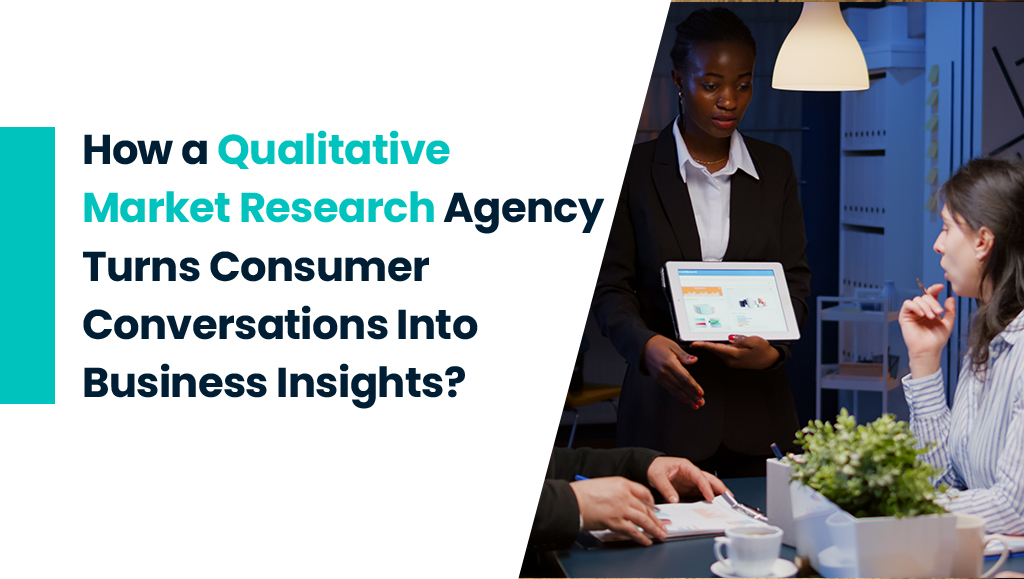
How a qualitative market research agency turns consumer conversations into business insight depends on what happens between the recording and the debrief. The power of qualitative research in market analysis is not the conversation itself. It is what happens next.
Insights Opinion delivers qualitative market research services across FGDs, IDIs, online communities, and IHUTs in 100+ countries and 60+ languages, from offices in New York, London, and Noida. Supported by ISO 27001, ISO 20252, and General Data Protection Regulation (GDPR) and California Consumer Privacy Act (CCPA)-aligned data practices.
Share your research brief or request a callback today.
- Email: bids@insightsopinion.com
- US: +1 646 475 7865
- UK: +44 20 3239 5786
- India: +91 120 359 4799
Frequently Asked Questions
How many participants are needed for qualitative research to be reliable?
FGDs run 6 to 8 per group. IDIs typically need 15 to 25 per segment. Add sessions until new themes stop appearing.
How long does a qualitative market research project take?
FGD programs run three to five weeks. IDI programs take four to six weeks. Community studies run five to eight weeks including analysis.
Can qualitative research be used alongside quantitative data?
Yes. Qualitative explains the patterns quantitative data measures. Run qualitative first to generate hypotheses or after quantitative to understand what the numbers mean.
What deliverables should I expect from a qualitative market research agency?
At minimum: a debrief presentation with findings, implications, and recommendations. Strong agencies also deliver verbatim libraries, stimulus material, and decision-specific briefs for internal stakeholders.
How do you ensure findings are not just the researcher’s interpretation?
Rigorous thematic analysis across the full session dataset, verbatim evidence attached to every key finding, and peer review of the analysis before client delivery.
When is qualitative research the wrong choice?
When you need statistical confidence at scale, or when the budget does not allow enough sessions to reach saturation. Those questions belong to quantitative methods.