You asked two agencies to price the same online survey. The quotes came back far apart. Now you’re not sure which one is fair, or what the cheaper one left out.
Here’s the short answer. CAWI survey costs depend mostly on who you need to reach. How many answers you need comes next, then how long the survey runs. Of these, the incidence rate tends to swing the price the most. That’s the share of people who actually qualify for your study.
At Insights Opinion, we run online surveys in 100+ countries and 60+ languages. We have access to 8M+ panellists. Our work is certified to ISO 20252 for research quality and ISO 27001 for data security.
Below, you’ll learn what drives the price and what a fair quote includes. You’ll also see where cheap quotes cut corners.
What Is a CAWI Survey, and What Are You Paying For?
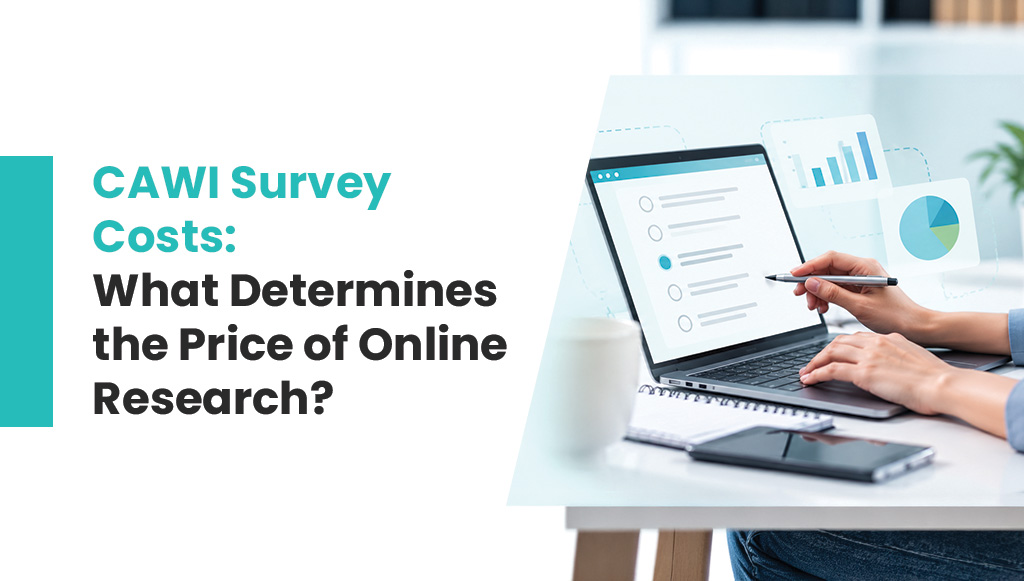
A CAWI survey is an online questionnaire that people fill in on their own phone or computer. CAWI stands for Computer-Assisted Web Interviewing. At Insights Opinion, it sits within our Online Surveys service. There are no callers or field staff to pay. So it’s often the lowest-cost way to reach large groups.
Most quotes bundle the same building blocks. Here’s what each one covers.
| Cost Component | What It Covers |
|---|---|
| Project management | Planning, setup and running the study |
| Survey programming | Building, routing and testing the survey |
| Sample | Paying for each valid, finished answer |
| Incentives | Rewards that respondents earn for taking part |
| Quality control | Removing fake, rushed or duplicate answers |
| Data processing | Cleaning, tables and analysis |
| Translation | Local versions for each market |
Sample is usually priced as cost per complete. That’s the price of one finished answer that passes all checks. The sample line also faces outside pressure. Per ESOMAR’s Global Prices Study 2025, panel companies are finding it harder to keep their panels large and high quality. Respondent incentives have also gone up in cost.
Which Factors Change CAWI Survey Price the Most?
Audience difficulty matters most. Volume and survey length follow. Here are the six factors that shape almost every CAWI survey price.
-
Incidence Rate
The incidence rate is the share of people screened who qualify. Say only 5 in 100 people fit your brief. The panel then has to screen 20 people for every one who completes. That screening effort shows up in your cost per complete.
-
Sample Size and Quotas
More completes cost more, but the link isn’t always simple. Quotas add another layer. These are minimum counts for groups, such as 200 women over 50 in the north. The last few hard-to-fill quota spots often cost the most.
-
Survey Length
Survey length is measured as LOI, or length of interview. It’s the number of minutes a survey takes. Longer surveys need bigger incentives. More people also quit halfway, so the panel must invite more people.
-
Consumer, B2B or Healthcare Audience
General consumers are the easiest to reach. Business buyers and doctors are not. ESOMAR’s Global Prices Study 2025 notes that B2B online prices have risen faster than CATI prices. B2B online now costs about the same as other methods. The reason is that finding B2B respondents still takes a lot of manual work. Our global research panels cover consumer, B2B and healthcare audiences.
-
Number of Markets and Languages
Each extra country adds translation and local testing. It also adds its own sample costs. Prices differ by market. So a five-country study isn’t just one study times five. Some markets cost far more per answer than others.
-
Turnaround Speed
Rush jobs cost more. Faster fieldwork means sending more invites at once and paying more for scarce people. See our guide to market research project timelines to plan ahead.
How Does CAWI Market Research Compare in Cost With CATI and Face-to-Face?
CAWI market research is usually the lowest-cost option for consumer studies. The gap shrinks for B2B work. ESOMAR’s Global Prices Study 2025 found that online quantitative projects tend to cost less than face-to-face or CATI studies. Online prices have also risen less sharply.
Paying more for another method can still make sense. Here’s when.
| Method | When the Extra Cost Is Worth It |
|---|---|
| CAWI (online) | Large samples, visuals and fast reads |
| CATI (phone) | Older, rural or offline audiences |
| CAPI (face to face) | Low internet use or product handling |
CATI stands for Computer-Assisted Telephone Interviewing, a survey run by trained callers. CAPI is its in-person version, with answers logged on a tablet. Is your audience hard to reach online? Then our CATI market research services may give you cleaner data for the money.
Is the Cheapest CAWI Quote a False Economy?
It can be. A low quote often saves money by skipping quality checks. Bad answers then slip into your data, and you pay for responses you can’t use.
Ask what the low quote leaves out. Look for these checks:
- Screening for bots and fake accounts
- Attention checks inside the survey
- Removing speeders, who rush through without reading
- Blocking duplicate answers from the same person
- A soft launch, a small first batch that catches errors early
- A clear answer on where the sample comes from
So compare quotes by cost per usable answer, not cost per complete. Here’s a simple test. Quote A delivers 1,000 completes, and 950 pass the checks. Quote B delivers 1,000 completes, but only 750 pass. Quote B needs to be a lot cheaper just to break even. And if the bad answers slip through unseen, you may act on the wrong result.
A cheap survey with bad data isn’t cheap. You’ll pay twice if you have to run it again. Insights Opinion follows ISO 20252 quality steps and GDPR and CCPA aligned practices on every project.

How Can You Lower CAWI Survey Costs Without Losing Quality?
Cut length and complexity first. Leave the quality checks alone. These five steps usually bring the price down the most.
- Trim the survey. Keep only questions tied to your decision. Every minute you cut lowers the incentive.
- Drop quotas you don’t need. Loose quotas fill faster and cost less.
- Test incidence first. A short feasibility check shows how hard your audience is to reach before you commit.
- Run markets together. One multi-country study shares setup costs across all markets.
- Design for mobile. Many people answer on a phone. A survey built for small screens keeps more of them to the end.
These steps work because they cut waste, not care. You can read more on the strengths of quantitative research when it’s planned well.
What Should a CAWI Quote Include When Choosing the Best Market Research Company?
The best market research company gives you an itemised quote, not a single total. That way you can compare like with like.
Before you sign, check that the quote shows:
- The cost per complete
- The incidence rate and survey length it assumes
- Where the sample comes from
- Which quality checks are included
- Whether incentives are built in
- What you’ll receive at the end
- What happens if incidence turns out lower
A clear quote also tells you how cost changes if the brief changes. Insights Opinion builds quotes this way across its quantitative research services, so you know what each line pays for.
Get a Fair Price for Your Online Survey with Insights Opinion
CAWI survey costs follow your audience. The harder people are to find, the more each answer costs. So define your audience tightly before you ask for quotes. Then compare quotes line by line, not just the total.
Planning an online survey? Share your brief with the Insights Opinion at bids@insightsopinion.com. Tell us your audience, markets and survey length, and we’ll send an itemised CAWI quote.
Frequently Asked Questions
What Does Cost per Complete Mean in a CAWI Survey?
It’s the price for one finished answer that passes all quality checks. Partial or rejected answers aren’t counted.
What Is the Minimum Sample Size for an Online Survey?
There’s no fixed minimum. It depends on how precise your results must be and how many groups you want to compare. Many studies use a few hundred completes per market.
Are Respondent Incentives Included in a CAWI Survey Price?
They usually are, inside the cost per complete. Ask your agency to confirm this in writing.
How Long Does a CAWI Survey Take to Complete?
A simple consumer survey can finish fieldwork in days. Niche, B2B or multi-country studies take longer.
Can You Run an Online Survey Using Your Own Customer List?
Yes. Using your own list can cut sample costs. You’ll need consent to contact those customers, and you’ll still need programming and quality checks.
Is a CAWI Survey Suitable for Healthcare Professionals?
Yes, for many topics. Doctors and nurses are harder to reach, so the cost per complete is higher. Consent and privacy rules must be followed at every step.