Your launch plan rests on answers from 300 cancer doctors. At least, that’s what the data says. But you’ve never seen how anyone checked that they’re real.
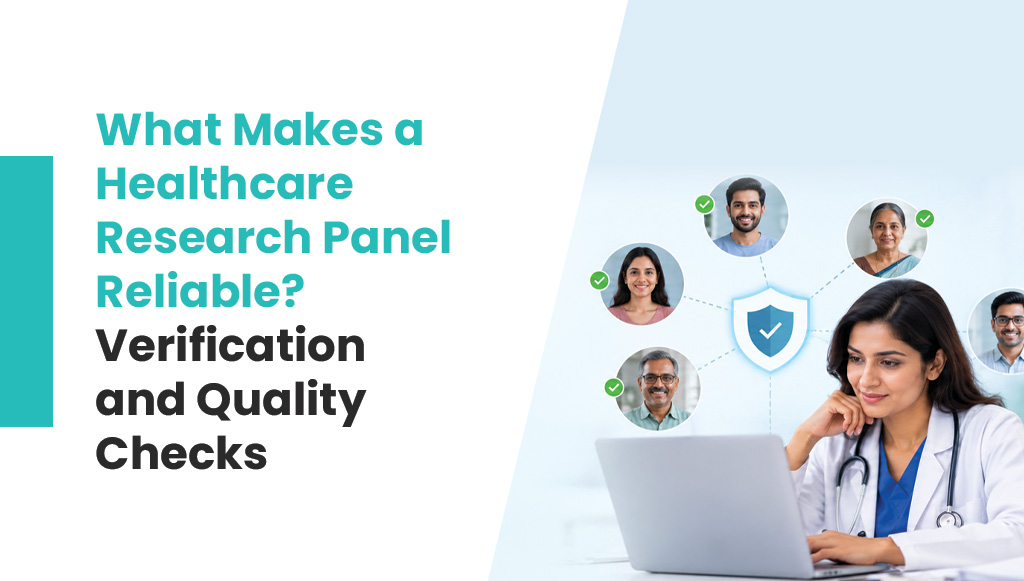
Here’s the short answer. A reliable healthcare research panel checks identity and licence when members join. It checks them again over time. It tests answers inside every survey. And it can show you proof that each check took place.
At Insights Opinion, health is one of our three core research areas. We run studies in 100+ countries and 60+ languages. Our work follows ISO 20252 for research quality and ISO 27001 for data security. We also follow GDPR and CCPA aligned practices.
Below, you’ll find the checks that matter most and makes healthcare research panel reliable. You’ll also get a short list of questions you can put to any panel provider before you sign.
How Does a Reliable Healthcare Panel Verify Its Members?
It works in layers. First, who the person is. Then, what they’re trained to do. After that, repeat checks for as long as they stay on the panel.
- Identity Checks – The first job is simple. Is this a real person, and just one person? Panels confirm name, email, phone and location. Many also log device details. That stops one person from signing up under several names.
- Licence Checks Against Official Registers – This step tells a real doctor apart from a fake one. Each person’s details are matched to a national register. In the US, that’s the NPI registry. In the UK, it’s the GMC register. In India, it’s the National Medical Register. A licence number alone isn’t enough. Good panels match several details at once.
- Specialty and Practice Setting Checks – A real doctor isn’t always the right doctor for your study. So panels confirm each person’s field and where they work. That might be a hospital, a private clinic or a teaching centre. Years in practice matter too.
- De-Duplication Across Panels- Some professionals sit on several panels at once. That’s allowed, but they shouldn’t answer your survey twice. De-duplication means spotting the same person across sources. Then they’re counted once.
- Regular Re-Validation – Licences lapse. Doctors retire, change roles or move country. Re-validation means checking members again on a set cycle. It’s not a one-time check on the day they joined.
- Patient and Caregiver Checks – Patients can’t be matched to a licence register. So checks look for answers that line up. A person’s profile and survey answers should tell the same story. Good panels never ask patients for medical records just to prove a condition.
Insights Opinion runs layered checks like these across its panels. Each one sits inside our ISO 20252 process.
What Quality Checks Should Run Inside Every Healthcare Survey?
Sign-up checks prove who joined. In-survey checks prove who’s answering today. They also show if people are paying attention.
The risk is real. A JMIR review of 13 studies found that 13% to 97% of survey answers were fake. Across all of them, the share was 61%. The same paper notes that open links carry more risk. An open link is a survey link anyone can find and use. A managed panel sends unique links to known members. That cuts the risk. It doesn’t remove it.
That’s why each healthcare survey needs its own checks:
- Clinical knowledge traps. Questions any real expert in the field would get right.
- Plausible numbers. A GP who claims 900 patients a day gets flagged.
- Specialty match. A skin doctor shouldn’t talk like a heart surgeon.
- Open answers that make clinical sense. Vague or copied text is a warning sign.
- Paying verified accounts only. Honoraria are the fees paid for taking part. They go only to checked members.
These sit on top of the usual online checks, such as bot and speed checks. We cover those in our guide to CAWI survey costs.
Do Interviews and Focus Groups Need Extra Verification in Healthcare Qualitative Market Research?
Yes. In healthcare qualitative market research, samples are small. So one wrong person can sway the whole study.
That’s why qualitative work adds a human checkpoint. A recruiter re-screens each person by phone before booking. When the session starts, the moderator checks ID again. In-depth interviews (IDIs) and focus group discussions (FGDs) also need an articulation check. That’s a quick test of whether someone can explain their views clearly. A real expert who can’t put thoughts into words won’t help much either.
A tight recruitment brief makes all of this easier. It spells out exactly who qualifies, so there’s less room for guesswork. Our healthcare research team builds these checks into each study like this.

Can Any Healthcare Panel Guarantee Every Respondent Is Real?
No. Treat a promise of zero fraud as a warning sign, not a selling point.
Fraud keeps changing, and no set of checks catches it all. What checks do is cut the risk a lot. They also help you find and remove bad data before it shapes a decision.
Here’s what happens when bad data stays in. One JMIR study received 646 valid records and 905 fraudulent ones from bot attacks. Leaving the fake data in would have changed the results in a big way.
So don’t ask for a guarantee. Ask for evidence instead:
- How many responses were removed on similar studies?
- How often are members re-validated?
- Can you see proof that the checks ran on your project?
That leads to the next question. If nothing is foolproof, what can you actually rely on?
What Standards Prove a Panel’s Checks Actually Happen?
Audited standards and written records. They turn “we check” into something you can confirm.
ISO 20252 is the global standard for market research quality. Outside auditors check the research process against it. ISO 27001 does the same for data security. Together, they show that checks are part of a system. They’re not a one-off effort.
Ask for project-level records too. A good provider can show which checks ran and what they found.
Industry codes set the bar as well. EPHMRA is the European body for pharma market research. Its 2025 Code of Conduct says research must be accurate, open and fair. It must also be of good quality. It’s also worth asking whether the team is trained to report adverse events. An adverse event is a side effect or drug problem someone mentions during research. That training shows a provider is set up for pharma work.
What Are the Best Practices for Researchers Choosing Healthcare Panels?
Ask every provider the same questions, and get the answers in writing. These best practices for researchers make it easy to compare panels side by side.
- Which registers do you check licences against?
- Do you verify members at sign-up, or later?
- How often do you re-validate members?
- How do you catch people who sit on more than one panel?
- Which in-survey checks come as standard?
- Is your research process audited under ISO 20252?
- Can you share removal rates from studies like mine?
Clear answers are a good sign. Vague ones aren’t. Strong healthcare panels answer all seven with ease. That’s how healthcare market research ends up resting on people who are who they say they are. You can see how our healthcare panels handle each point.
Choose a Panel You Can Trust With Insights Opinion
A reliable healthcare research panel doesn’t ask for blind trust. It shows its checks, from licence matching to in-survey traps. It also gives you records to prove they ran. Put the seven questions above to any provider on your list.
Planning healthcare market research with doctors, nurses or patients? Talk to the Insights Opinion about how we verify healthcare respondents for your next project. Email us at bids@insightsopinion.com.
Frequently Asked Questions
Does Verification Work the Same Way in Every Country?
No. Each country has its own licence registers and data rules. A global panel needs local checks in every market, not one process for all.
Are Rare Specialists Harder to Verify?
They’re harder to find than to check. Because they’re scarce, fake sign-ups target them more. Extra care at screening pays off.
What Happens to Answers That Fail Quality Checks in a Healthcare Survey?
They’re taken out of the data. Most times, they’re swapped for fresh, valid ones. Repeat offenders should be taken off the panel.
Is an Opt-In Healthcare Panel More Reliable Than a Bought Contact List?
Usually, yes. Opt-in members have agreed to take part, and they’ve been checked. A bought list gives you contact details. It doesn’t prove who will answer.
Can Verified Doctors Still Give Poor-Quality Answers?
Yes. A real doctor can still rush or lose focus. That’s why in-survey checks matter as much as sign-up checks.
Are Bigger Healthcare Panels More Reliable?
Not on size alone. A smaller panel with strict checks can be more reliable than a large one with weak checks. Ask how members are verified, not just how many there are.