
Surveys can lose accuracy before fieldwork even starts. Unclear questions, weak screeners, poor respondent quality, rushed answers and manual coding errors can all affect the reliability of the final data.
Generative AI is improving survey accuracy and data collection by supporting better questionnaire design, sharper screening, real-time quality checks, faster open-ended response analysis and cleaner data processing. This is why the Role of AI in Improving Survey Accuracy is becoming important for modern research teams.
AI adoption is also growing fast. McKinsey reported that 71% of organisations regularly used generative AI in at least one business function in 2024, up from 65% earlier that year. It also found that 78% used AI in at least one business function.
As a global market research company, Insights Opinion supports AI-ready survey workflows with online surveys, CATI, CAPI, CLT, survey programming, translation and data insights across 100+ countries, 60+ languages and 8M+ global panellists.
How Generative AI Improves Survey Questions Before Fieldwork Starts?
Generative AI improves survey accuracy by helping researchers create clearer, shorter and more neutral questions before data collection begins.
Poor question design is one of the biggest reasons survey data becomes weak. If a question is confusing, respondents may guess, skip it or answer in a way that does not reflect their true opinion.
This is where Generative Artificial Intelligence adds value. It can help research teams review survey questions for clarity, tone, bias and flow before launch.
It can support researchers by:
- Rewriting confusing questions in simpler language.
- Checking whether a question leads the respondent.
- Suggesting more balanced answer choices.
- Finding double-barrelled questions.
- Improving question order for smoother flow.
- Creating audience-specific versions for consumer, B2B or healthcare studies.
This matters because AI is now becoming part of mainstream business workflows. Stanford HAI’s 2025 AI Index reported that 78% of organisations used AI in 2024, up from 55% in 2023. It also reported that global private investment in generative AI reached $33.9 billion in 2024, an 18.7% increase from 2023.
How AI Helps Build Stronger Screeners For The Right Respondents?
AI improves data collection by helping researchers screen respondents more accurately and reduce poor sample matches.
A survey is only useful when the right people answer it. Even a well-written questionnaire can fail if it reaches the wrong audience.
The Role of AI in Improving Survey Accuracy becomes clear in screener design. AI can help check whether screening questions are too broad, too easy to guess or too likely to allow irrelevant respondents into the study.
For example, in a healthcare professional survey, AI can help review whether the screener properly separates physicians, specialists, decision-makers and non-qualified respondents. In a B2B study, it can help refine job role, company size and purchase authority questions.
AI can support stronger screening by:
- Reviewing qualification paths.
- Detecting weak screener logic.
- Helping build better quota groups.
- Flagging inconsistent respondent profiles.
- Reducing irrelevant survey completes.
This is important because poor respondent quality can distort findings. Pew Research Center found that online opt-in polls can produce misleading results when bogus respondents provide insincere answers. In one example, 12% of U.S. adults under 30 in an opt-in survey claimed they were licensed to operate a nuclear submarine, even though the real share rounds to 0%.
How Generative AI Reduces Survey Bias And Response Confusion?
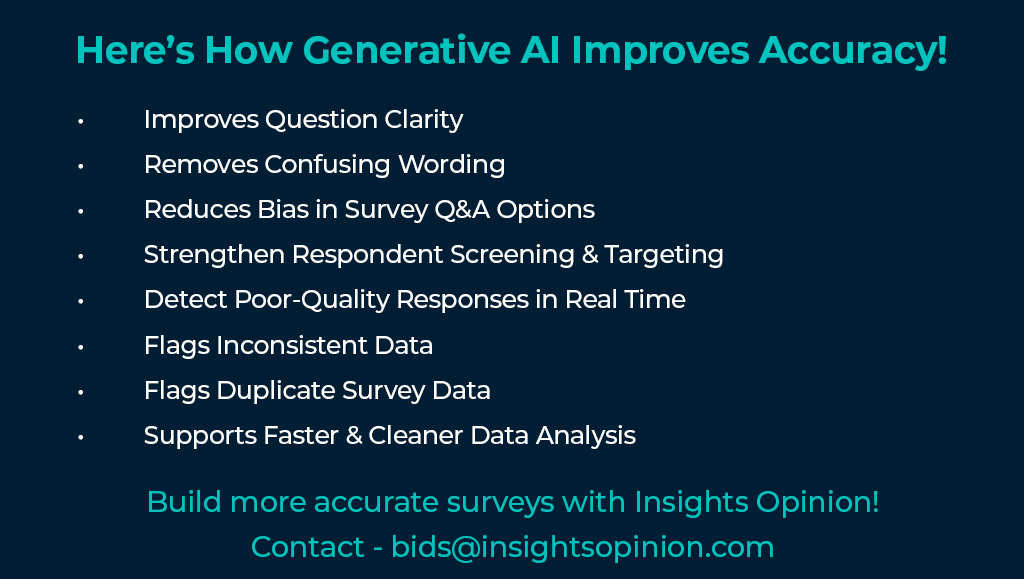
Generative AI reduces survey bias by checking wording, tone, answer options and question order for possible confusion.
Bias often appears in small ways. A question may sound neutral to the researcher but still push a respondent toward one answer. A scale may favour positive choices. A phrase may not translate clearly across markets.
AI can help researchers spot these issues before launch.
For example, it can flag:
- Loaded wording.
- Uneven answer scales.
- Vague terms such as “often” or “regularly.”
- Questions that ask two things at once.
- Missing neutral options.
- Language that may not work across regions.
This is especially useful in multilingual research. Insights Opinion supports translation and localisation across 60+ languages, which makes cultural clarity important for accurate data collection.
How AI Detects Poor-Quality Survey Responses In Real Time?
AI improves survey accuracy by flagging rushed, repeated, inconsistent or suspicious responses while data collection is still active.
Poor-quality responses are a major concern in online surveys. Pew Research Center explains that opt-in surveys are vulnerable to bogus respondents, including people who are ineligible or provide insincere responses.
AI can help protect survey data by identifying patterns that may be missed in manual checks.
It can flag:
- Straight-lining across grid questions.
- Very fast survey completion.
- Repeated answer patterns.
- Contradictory answers.
- Duplicate or suspicious entries.
- Weak open-ended responses.
- Bot-like behaviour.
This is useful because issues can be caught while fieldwork is still running. Research teams can pause, review, replace poor completes or adjust quality checks before the final dataset is affected.
How AI Improves Data Collection Speed Without Sacrificing Quality?
AI improves data collection speed by helping research teams monitor quotas, review response quality and correct fieldwork issues faster.
Speed matters in modern research, but fast data is not useful if it is unreliable. AI helps by giving teams earlier signals during fieldwork.
It can support:
- Faster quota tracking.
- Real-time quality monitoring.
- Early identification of low-performing segments.
- Faster respondent validation.
- Better fieldwork decisions.
- Cleaner handoff between collection and analysis.
This matters for large-scale, multi-market surveys where manual checks can slow the process. Insights Opinion’s multi-method capabilities, including online surveys, CATI, CAPI and CLT, make this especially relevant for studies that need both scale and control.
How AI For Survey Data Analysis Improves Open-Ended Responses?
AI for Survey Data Analysis helps researchers organise open-ended answers into clear themes, patterns and sentiment groups.
Open-ended questions are valuable because they capture the respondent’s own words. They can reveal motivations, frustrations and hidden needs that closed-ended questions may miss.
The challenge is scale. If a study receives hundreds or thousands of open-text answers, manual coding can take time and may become inconsistent.
AI can help by:
- Grouping similar responses.
- Finding repeated concerns.
- Identifying sentiment patterns.
- Supporting faster coding.
- Comparing themes across segments.
- Highlighting unusual or emerging responses.
This improves speed, but it does not remove the need for expert review. McKinsey found that only 27% of respondents whose organisations use generative AI said employees review all AI-created content before use. That makes human oversight essential when AI is used in research analysis.
How AI Reduces Manual Errors In Survey Data Cleaning?
AI reduces manual errors by helping researchers identify inconsistent data, missing patterns and unusual response behaviour faster.
Data cleaning is where accuracy becomes visible. Even after fieldwork ends, researchers must review whether the dataset is complete, consistent and usable.
This is where AI for Survey Data Analysis works with strong data processing services to improve consistency, reduce manual review errors and prepare cleaner datasets.
AI can support this stage by checking:
- Missing responses.
- Contradictory answers.
- Unusual patterns.
- Duplicate entries.
- Inconsistent coding.
- Segment-level data gaps.
- Outliers that need review.
This also supports quantitative data analysis services, because clean datasets make cross-tabs, segmentation, dashboards and reports more reliable. McKinsey also found that 47% of respondents said their organisations had experienced at least one negative consequence from generative AI use, compared with 44% earlier in 2024. This reinforces the need for accuracy checks, privacy safeguards and human validation.
Where Generative AI Improves The Survey Workflow Most?
Generative AI adds the most value when it improves accuracy across the full survey workflow, not just one step.
| Survey Stage | How Generative AI Improves Accuracy |
|---|---|
| Question design | Improves clarity and reduces bias |
| Screening | Helps qualify the right respondents |
| Fieldwork | Flags poor-quality responses faster |
| Open-ended responses | Groups themes and sentiment patterns |
| Data cleaning | Reduces manual review errors |
| Reporting | Helps turn clean data into clearer insights |
This shows that Generative Artificial Intelligence is not just a reporting tool. It can support better survey quality from the first draft of the questionnaire to the final insight summary.
Why Generative AI Still Needs Human Research Expertise?
Generative AI can improve survey quality, but human researchers are still needed to validate logic, context, ethics and final insights.
AI can identify patterns, but it cannot fully understand the business context behind a study. It can suggest better wording, but a researcher must decide whether that wording fits the research objective. It can group responses, but a human expert must decide what those themes mean for the client.
This is even more important in healthcare, B2B and sensitive consumer studies. These projects need stronger screening, privacy controls, compliance and careful interpretation.
Insights Opinion’s quality and compliance framework supports this need through ISO 27001, ISO 20252 and GDPR/CCPA aligned practices.
How Insights Opinion Supports More Accurate AI-Ready Survey Research?
Insights Opinion supports accurate survey research through strong research design, global respondent access, data quality checks, secure handling and expert analysis.
The company’s research ecosystem connects well with AI-ready survey workflows because it covers the stages where accuracy matters most.
Insights Opinion supports brands with survey programming, quantitative data analysis services, data processing services, dashboards and reporting that turn collected responses into reliable insights.
Its capabilities include:
- Global reach across 100+ countries.
- 60+ language support.
- Access to 8M+ global panellists.
- Online surveys, CATI, CAPI and CLT.
- Survey programming and logic checks.
- Translation and localisation.
- Data cleaning, tabulation and dashboards.
- Secure and compliant data handling.
This makes Insights Opinion a strong partner for businesses that want faster survey data without losing accuracy, context or quality control.
Build More Accurate Surveys With Insights Opinion
Better survey accuracy needs the right mix of AI support, strong research design, verified respondents and expert interpretation.
If you need a market research company that combines verified respondents, quality checks, quantitative data analysis services and expert-led interpretation, Insights Opinion can support your next survey project.
To plan your next survey research project, contact Insights Opinion:
- US: +1 646 475 7865
- UK: +44 20 3239 5786
- India: +91 120 359 4799
- Email: bids@insightsopinion.com
FAQs
1. How does Generative AI improve survey accuracy?
Generative AI improves survey accuracy by helping researchers write clearer questions, reduce bias, detect poor-quality responses and analyse answers faster. It works best when researchers review and validate every AI-supported output.
2. What is the role of AI in improving survey accuracy?
AI helps improve accuracy by checking question quality, respondent fit, response patterns and data consistency. It supports better decisions across design, fieldwork and analysis.
3. Can AI detect poor-quality survey responses?
Yes, AI can flag straight-lining, speeding, duplicate patterns, contradictions and weak open-ended answers. Researchers still need to review these flags before removing any responses.
4. How does AI improve survey data collection?
AI improves survey data collection by helping teams monitor quotas, validate respondents and spot fieldwork issues faster. This helps protect data quality while the study is still active.
5. How does AI help with open-ended survey responses?
AI can group open-ended responses into themes, sentiment patterns and repeated concerns. This makes large text-based datasets easier to review and interpret.
6. Is AI for Survey Data Analysis reliable?
AI can make survey analysis faster and more consistent, but it should not work without human review. Expert researchers are needed to check context, accuracy and business meaning.
7. Does Generative AI replace human researchers?
No, Generative AI supports researchers but does not replace them. Human expertise is still needed for research design, ethical checks, interpretation and final recommendations.
8. Why choose Insights Opinion for AI-ready survey research?
Insights Opinion combines global data collection, multilingual research support, survey programming, data cleaning and compliance-led processes. This helps businesses collect accurate and reliable survey data at scale.