You need insights from a very specific group of people. Experienced surgeons. Senior procurement heads. Power users of a niche product. Random sampling will not reliably find them. By the time you screen a large random pool down to qualified respondents, you have spent weeks and a significant portion of your budget, and you still may not have the right people in front of you.
Judgmental sampling solves this. It is a non-probability method where the researcher hand-picks participants based on knowledge and judgment, not chance. The sample is small, targeted, and built entirely around the people who can actually answer your research question.
At Insights Opinion, a global market research partner operating across 100+ countries and 60+ languages, judgmental sampling is a core part of how qualitative studies are designed, from healthcare panels to B2B expert interviews. This blog covers the judgmental sampling definition, real-world examples from Nike, P&G, and Roche, the core advantages, and when to use it versus when to avoid it.
What Is the Judgmental Sampling Definition?
Judgmental sampling is a non-probability research technique in which participants are chosen solely on the basis of the researcher’s judgment about who will best serve the study’s information needs.
- It is also called purposive sampling, authoritative sampling, or expert sampling.
- The selection process is intentional.
- The researcher defines the characteristics a participant must have: a specific professional role, a clinical background, a purchase behaviour, or a level of category experience.
- Anyone who does not meet those criteria is excluded.
- From those who do qualify, the researcher selects participants based on their relevance to the study objective.

How Does Judgmental Sampling Compare to Random Sampling?
| Feature | Judgmental Sampling | Random Sampling |
|---|---|---|
| Selection basis | Researcher’s judgment and defined criteria | Equal probability for all population members |
| Sample type | Non-probability | Probability |
| Best suited for | Qualitative, exploratory, expert-led studies | Large-scale studies needing statistical generalisability |
| Recruitment speed | Faster: criteria-driven selection | Slower: requires complete population list |
| Bias risk | Higher: researcher subjectivity applies | Lower: randomisation reduces personal bias |
| Output type | Depth and contextual insight | Statistical representation |
The difference is purpose. Random sampling is built for representativeness across a full population. Judgmental sampling is built for depth from a precisely defined group.
What Are Real-World Judgmental Sampling Examples?
The clearest judgmental sampling examples come from sectors where the research question can only be answered by a very specific type of person. Here is how three globally recognised organisations have applied this approach, and what it tells you about when this method delivers.
-
Nike: Elite Athlete Selection for Performance Research
Nike restricts performance product testing to affiliated elite athletes in basketball, football, and running, not general consumers. Consumer Goods Technology confirmed this approach extends to concept research, where Nike used targeted SNKRS app member polling to develop the Air Max 1 ’87. CEO John Donahoe called it a “full-circle insights-to-shopping experience.” Small sample, strict criteria, directly relevant respondents. That is judgmental sampling working exactly as intended.
-
Procter and Gamble: Targeted Consumer Recruitment for Product Development
According to a MarketingSherpa case study, P&G’s FemCare division Principal Scientist replaced broad open recruitment with deliberate consumer selection, choosing participants based on direct product experience. The Case Centre’s documentation confirms P&G applies this across categories, using pre-selected groups for in-home visits and Focus Group Discussions. The best market research company applies the same logic: build the sample around the people whose input shapes the decision.
-
Roche: Specialist Physician Selection in Healthcare Research
When Roche and other pharmaceutical companies run pre-launch oncology studies, they recruit practising oncologists with direct prescribing experience, not general practitioners. A 2024 paper in the Journal of Medical Evidence confirms that clinical qualitative studies benefit significantly from purposive sample construction. According to ESOMAR, the global market research industry reached USD 140 billion in 2024, with healthcare research a major contributor. Verified specialist access is what makes the method work.
-
B2B Research: Reaching Decision-Makers, Not Just Job Titles
Testing a new supply chain product requires input from procurement managers with direct vendor evaluation authority, not junior staff. A 2024 ScienceDirect paper in the Journal of Business and Industrial Marketing found purposive sampling is the most commonly used method in B2B marketing research from 2013 to 2023. A big market research company with verified B2B panel access builds that sample in days. Without the infrastructure, the same task takes months.
What Are the Key Advantages of Judgmental Sampling?
The judgmental sampling advantages that matter most show p at the fieldwork stage, where time, respondent quality, and budget directly affect the data you get.
It saves significant research time.
There is no large-scale screening of a broad population. The researcher defines the criteria upfront. Recruitment targets only qualifying individuals, cutting weeks from the process.
It puts the right respondents in the study.
A random sample of 200 people may include five who hold genuinely relevant knowledge. A judgmental sample of 20 can be built entirely from that relevant group. Data quality improves because the sample is precise, not because it is large.
It works for rare or hard-to-reach populations.
When the target group is small, such as rare disease patients, niche industry specialists, or C-suite decision-makers in a specific vertical, judgmental sampling is often the only viable option. Random methods cannot surface these groups at useful volumes.
It is the natural fit for qualitative research methods.
Focus Group Discussions, In-Depth Interviews, and In-Home Use Tests all produce stronger data when participants have directly relevant experience. Judgmental selection is how researchers build those participant pools correctly from the start.
It is cost-efficient for studies with limited budgets.
Smaller, better-targeted samples cost less to recruit, brief, incentivise, and analyse than large, broadly-defined ones. For a pilot study or exploratory phase, this keeps research affordable without sacrificing data quality.
It supports near-real-time insight generation.
Because the target group is already defined and accessible, data collection moves faster. Quick expert interviews and focused qualitative studies can be completed and analysed within days when the sample criteria are clearly defined from the outset.
When Should You Use Judgmental Sampling?
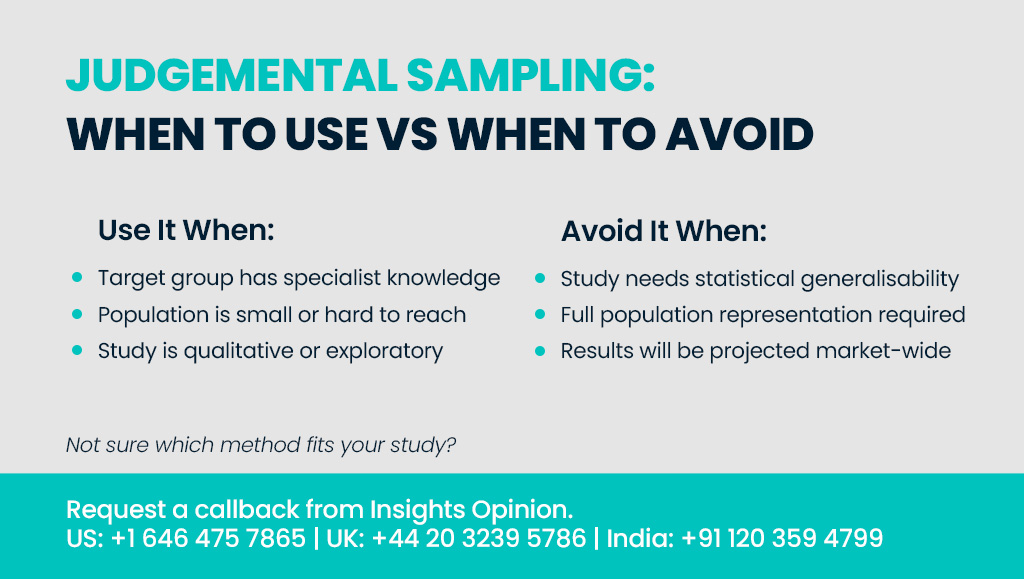
Use judgmental sampling when the research question requires a specific type of person and that type of person cannot be reliably found through random selection.
Three conditions signal it is the right choice:
- The target audience holds specific expertise, occupies a defined professional role, or has a usage or behavioural characteristic that is essential to the study
- The population is small, rare, or structurally difficult to reach through standard panel or random recruitment
- The study is qualitative, exploratory, or at pilot stage, where depth of insight matters more than statistical generalisability
It is not the right choice when the goal is statistical representation of a large general population, or when findings need to be numerically projected across a wider market. Those studies call for probability methods: random, stratified, or systematic sampling.
Plan Your Qualitative Study With Insights Opinion
Judgmental sampling works when the right people are in the room. Getting there requires precise recruitment criteria, verified respondent access, and a research team that understands your sector deeply.
Insights Opinion designs and executes qualitative research studies across Focus Group Discussions, In-Depth Interviews, In-Home Use Tests, healthcare research, and B2B research, across 100+ countries and 60+ languages, from offices in New York, London, and Noida.
Insights Opinion brings that operational depth to every study, supported by ISO 27001 and ISO 20252 quality standards, GDPR and CCPA-aligned data practices, and a verified global panel of 8M+ respondents across consumer, B2B, and healthcare segments
Whether you need verified specialist physicians, confirmed B2B decision-makers, or category-specific consumers with defined usage profiles, the team builds the right sample for your study from day one.
Share your research brief or request a callback today.
- Email: bids@insightsopinion.com
- US: +1 646 475 7865
- UK: +44 20 3239 5786
- India: +91 120 359 4799
Frequently Asked Questions
What is the difference between judgmental sampling and purposive sampling?
They are the same method. Purposive sampling, judgmental sampling, authoritative sampling, and expert sampling all describe the same non-probability technique where the researcher selects participants based on judgment and defined criteria. The terms are used interchangeably across published research literature.
When is judgmental sampling most useful in market research?
It is most useful when the study needs insight from a specific, hard-to-reach group: clinical specialists, senior business decision-makers, category-level product users, or experts in a niche sector. It is the standard choice for qualitative methods like Focus Group Discussions and In-Depth Interviews, where participant relevance directly determines data quality.
What are the limitations of judgmental sampling?
The main limitations are researcher bias in participant selection, the inability to generalise findings statistically to a wider population, and dependency on the researcher’s sector knowledge and respondent access. These risks reduce significantly when the study is designed and executed by an experienced research partner with verified recruitment infrastructure and documented quality controls.
How is judgmental sampling different from convenience sampling?
Convenience sampling selects participants based on who is easiest to reach. Judgmental sampling selects based on who is most relevant to the research question. Convenience sampling introduces availability bias. Judgmental sampling introduces researcher bias. For studies needing expert or specialist insight, judgmental sampling produces far more decision-useful data.